The Iglu Guide | Blog
How to spot eco-friendly student accommodation
When it comes to saving the planet, the mission doesn’t stop when you head off to university. In fact, for many burgeoning eco-warriors this is just the beginning. Because when it comes to selecting options for student accommodation, your choice has never been more important. Searching for eco-friendly student accommodation buildings is not just about reducing your environmental impact, it’s about harnessing those important design features that can help make everyday life more comfortable, affordable, and healthy for the long term. Knowing what to look for can help you find a space that supports both your lifestyle and the planet – all at the same time. Here’s what you need to know.
Location
Living in a sustainable location is about being situated close by to your everyday amenities such as your uni building, supermarkets, and transport options. Iglu buildings offer students a fantastically convenient location, whether in Sydney, Melbourne or Brisbane, with transport, lifestyle and entertainment options right on your doorstep.
When it comes to making more sustainable living choices, easy access to local infrastructure can have a major impact on your lifestyle and environmental footprint. Living closer to campus facilities and public transport will lower commuting times and transport costs whilst also reducing emissions and the need for car usage. That leaves more time for socialising and wellbeing activities, helping to maintain a happy and healthy mind.
Building orientation
How a building is positioned plays an important role when it comes to taking advantage of natural resources. As Australia has a predominately warm climate, Iglu student accommodation buildings are intentionally designed to maximise any natural light and optimise airflow, whilst protecting against excessive heat.
Well-thought-out building orientation can make student accommodation significantly more comfortable all year round, as well as positively impact the environment. Using large windows and skylights to harness natural light keeps rooms feeling bright and fresh, whilst capturing the natural breeze enables improved airflow. Shutters are also highly effective at keeping rooms cool in the summer months. Environmentally, this lowers energy consumption and reduces spending on heating and cooling. Purpose-built student accommodation is more likely to support sustainable living goals than older buildings, as these considerations are naturally incorporated at the design stage.
Ventilation and humidity
Airflow and humidity are important consideration factors, particularly in cities like Brisbane and Sydney where the summer weather conditions can be very hot and sticky. Without mitigation factors, living conditions can become quickly uncomfortable which impacts quality of life.
Good ventilation can help your accommodation feel cooler and fresher which makes for a more comfortable study environment. Harnessing the natural airflow can also help reduce condensation and dampness which encourages mould growth and can contribute to allergies and respiratory issues. Look for well-insulated windows with shading options included and check for internal breeze ways. This natural ventilation can help reduce heat and moisture – which in turn lowers your reliance on energy usage and reduces carbon emissions.
Green spaces
Access to nearby parks and green spaces is an important aspect of sustainable living as they improve the environmental performance of the building as well as personal wellbeing. Additionally, eco-friendly buildings are often innovatively designed to bring the outside in, using courtyard areas, rooftop spaces and outside seating opportunities.
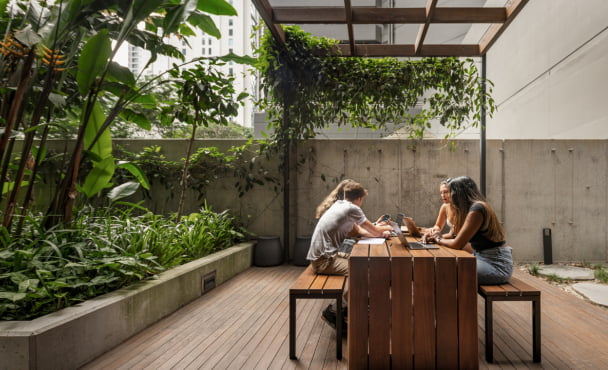
Access to green spaces can help living spaces feel calmer, healthier and more enjoyable. Outdoor communal areas provide spaces to relax, socialise and study away from the bedroom which aids study habits. Plants and landscaping also play an important role in naturally cooling buildings and improving air quality. Several Iglu buildings such as Iglu Melbourne City, Iglu Summer Hill, and Iglu Mascot include landscaped courtyards and rooftop gardens all designed to support student wellbeing, a strong sense of community and more sustainable living habits. Many Iglu buildings are also located close to parks, walking tracks and waterfront areas that encourage a more active lifestyle and a more balanced student environment.
Shared spaces
Communal areas are an important aspect of student accommodation and are designed for studying, socialising, and everyday living. They can range from shared kitchen spaces and rooftop terraces to study areas, gyms, games rooms and BBQ spaces. This type of approach encourages more sustainable living habits such as shared cooking, and lower consumption.
Well-designed communal spaces encourage greater personal interaction and integration, facilitating both student wellbeing and sustainability goals. Shared facilities promote a more efficient usage of electricity, lighting, heating and appliances, which reduces the overall energy consumption when compared to individual usage habits. Shared spaces also encourage a greater sense of community, which can be highly valuable to international students adjusting to a new city. Overall, they make student accommodation a more welcoming place whilst maximising resources which is particularly valuable in high density urban areas.
Image: Iglu Brisbane City
Frequently asked questions
Eco-friendly student accommodation combines several key design features, including sustainable location, smart building orientation, good ventilation, access to green spaces, and well-designed shared facilities. Together, these elements reduce environmental impact while making everyday student life more comfortable and affordable.
Being close to your university, public transport, and local amenities means you can walk or take public transport instead of relying on a car. This cuts commuting costs, reduces emissions, and frees up more time for socialising and wellbeing.
Features like large windows, skylights, shutters, and well-positioned breezeways regulate natural light, temperature, and airflow, keeping your room comfortable year-round without heavy reliance on heating or air conditioning.
Yes, shared kitchens, study areas, gyms, and communal lounges mean appliances, lighting, and heating are used collectively rather than duplicated across individual rooms. This significantly lowers overall energy consumption while also fostering a stronger sense of community.
Generally, yes. Purpose-built accommodation incorporates sustainable design principles from the ground up, such as optimal building orientation and efficient ventilation, whereas older buildings often require costly retrofitting to achieve the same results.